Diamond Prices
Read more

Is My Diamond Real? 6 Home Tests and What Only a Lab Can Tell
Six home tests that rule out the most common imitations in five minutes, the myths that can break your stone, and the one check that really settles it.
Short answer: home tests can tell a diamond from glass or cubic zirconia. They cannot tell it from moissanite or a lab-grown diamond. For that you need a lab report, or a trained eye with the right instruments.
Free online diamond tester
Test your stone, step by step
Mark each result as you go. Your verdict builds on the right. You don’t need any special tools, just your breath, a printed page, a light and ideally a 10× loupe.
Read this first: these tests are a filter, not a guarantee.
✓ What they can doRule out the most common look-alikes: glass, cubic zirconia, crystal and most white sapphires.
✕ What they can’t doProve your stone is a diamond. Moissanite and lab-grown diamonds pass most or all of them, and so can a skilled fake.
A stone that passes is “not a common imitation”. Only a gem lab, or an expert with instruments, can confirm it’s a real diamond.
- The fog test: Diamond spreads heat fast, so the fog is gone in 1–2 seconds. Glass and cubic zirconia stay misty for several seconds.
- The read-through test: A well-cut diamond bends light so strongly that you can’t read the letters or see the line. Clear lettering points to glass or CZ.
- The loupe test: Diamond edges stay razor-sharp; glass and CZ look worn or rounded. Doubled back facets mean moissanite.
- The sparkle test: Diamond returns mostly bright white light with some flashes of color. A strong rainbow “disco” effect points to CZ or moissanite.
- The setting and stamp: 585, 750, 950 or PT marks real gold or platinum. “CZ”, or “925” (silver) with a large stone, is a strong warning sign.
- The UV clue: About a third of diamonds glow, usually blue. A glow is a good sign, but no glow proves nothing, so this test can only help.
Compare
Diamond vs. the usual look-alikes
What you can expect from each home test. Notice the last two columns: they behave just like a diamond.
| Diamond | Glass | Cubic zirconia | White sapphire | Moissanite | Lab-grown diamond | |
|---|---|---|---|---|---|---|
| Fog clears in 1–2 seconds | Yes | No | No | Slower | Yes | Yes |
| You can’t read print through it | Yes | No | Often not | No | Yes | Yes |
| Sharp facet edges (loupe) | Yes | Worn | Soft | Yes | Yes | Yes |
| Doubled back facets (loupe) | No | No | No | Slight | Yes | No |
| Sparkle | White + some color | Dull | Strong rainbow | Weak, glassy | Strong rainbow | White + some color |
| Heavier than it looks | — | — | Yes, about 1.7× | A little | — | — |
| Can home tests spot it? | — | Yes | Yes | Mostly | Loupe only | No, lab only |
Simplified for home testing. Results vary with cut, size and setting.
Please don’t
Tests that don’t work, or damage your stone
You’ll find these all over the internet. We see the results in Antwerp.
Breaks diamonds
The hammer test
Diamond is hard, not tough. One blow at the wrong angle can split it along its grain, and a chipped diamond loses much of its value.
Proves nothing
Scratching glass or sandpaper
Moissanite, sapphire and even some quartz scratch glass too. And you can chip a real diamond’s edge, or the stone next to it.
Proves nothing
The water glass test
“A diamond sinks.” So do cubic zirconia and glass. It tells you nothing.
Risky
Heating, then cooling it
Thermal shock can crack stones with inclusions and ruin settings and other gems in the jewel.
Fooled easily
Cheap pen testers
Most basic heat testers say “diamond” for moissanite, and every tester says “diamond” for lab-grown, because it is diamond.
Half true
“Real diamonds glow under UV”
Only about a third do, usually blue. No glow doesn’t mean fake. Treat it as a clue, never as proof.
Real proof
What really settles it: three checks
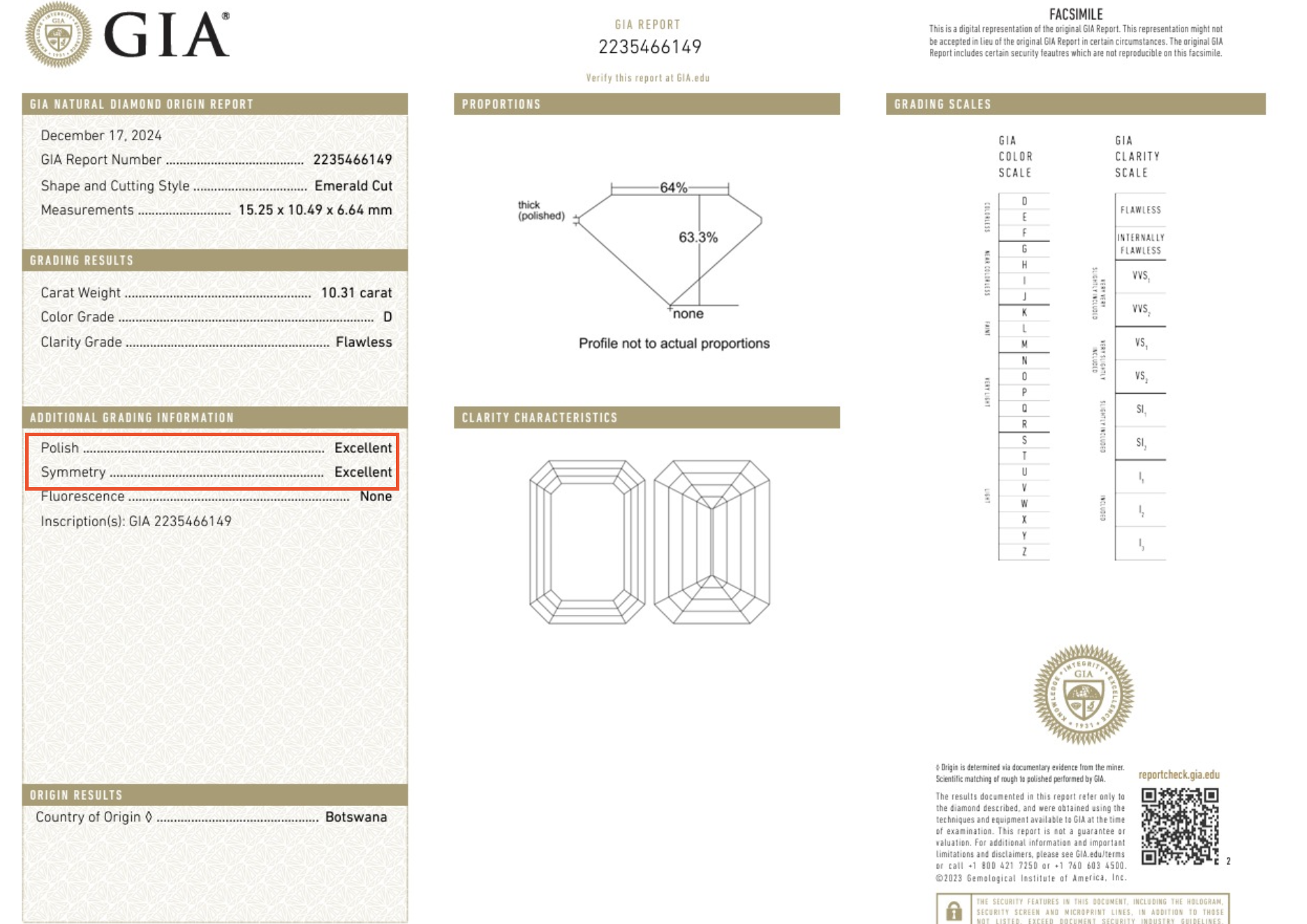
- An independent lab reportGIA, HRD or IGI. It states what the stone is, natural or laboratory-grown, and its grades.
- Check the number onlineEnter the report number on the lab’s own website (for example GIA Report Check). The weight, measurements and grades must match your stone.
- Find the laser inscriptionMost graded diamonds carry the report number on their edge (the girdle), tiny but readable with a 10× loupe. Same number, same stone.
At Ajediam, we show you the lab report and the matching inscription under the loupe before you buy.
The question we hear most
“Is it natural or lab-grown?”
A lab-grown diamond is a real diamond: same carbon, same hardness, same sparkle. That’s why every home test, and every pen tester, says “diamond”.
Only a gem lab, with instruments that read how the crystal grew, can tell the two apart. Lab reports say it clearly (“Laboratory-Grown”), and the inscription often starts with “LG”.
Many diamond traders and jewelers also have a lab-grown screening machine (such as the GIA iD100). In a few seconds it confirms a natural diamond, or flags a stone that may be lab-grown so it can be sent to a gem lab. Ask your jeweler if they have one.
Next step
What brings you here?
Pick one, and we’ll point you to the right next step.
FAQ
Quick answers
How can I tell if my diamond is real at home?
Breathe on it (the fog should clear in 1–2 seconds), try to read print through a loose stone, and look at the facet edges with a 10× loupe. These tests rule out glass and cubic zirconia, but they can’t prove a stone is a diamond.
Can a jeweler tell if my diamond is real?
Most jewelers can tell diamond from glass or cubic zirconia in seconds with a tester and a loupe. Telling natural from lab-grown needs lab equipment, so ask for a lab report if the stone is valuable.
Does a real diamond sparkle like a rainbow?
Some color, yes, but mostly bright white light. A strong “disco” rainbow points to moissanite or cubic zirconia.
Do lab-grown diamonds pass a diamond tester?
Yes. A lab-grown diamond is real diamond, so every home test and pen tester says “diamond”. Only a gem lab can tell natural from lab-grown.
My diamond has no certificate. Is it fake?
Not at all. Many older or smaller diamonds were never graded. You can still have it identified and graded today.
Is “CZ” stamped inside the ring a bad sign?
Yes. “CZ” means cubic zirconia. Real gold or platinum is usually stamped 585, 750, 950 or PT. A cheap metal setting makes a large real diamond unlikely.