Diamond Prices
Read more

GIA explained: the lab, the report and the scales in numbers
What GIA is, how to read its report, which report you need, and what even the best lab can’t promise.
Short answer: GIA, the Gemological Institute of America, created the 4Cs and is the strictest, most recognised lab for natural diamonds. A GIA report helps resale more than any other. But grading is done by people: it is a strong reference, never a total guarantee.
Have a GIA report? · Free tool · 1 minute
Check that your GIA report is real
Type the number. We open GIA’s official check and tell you what to compare.
Check my report →At a glance
GIA in numbers
1931Founded by Robert M. Shipley
1953First diamond grading report
23Colour grades, D to Z
11Clarity grades, FL to I3
5Cut grades, Excellent to Poor
0.15 ctSmallest stone graded alone
10Digits in a report number
0Labs that never make a mistake
Good to know
A lab is made of people
Behind every report are trained graders, and people can make mistakes. Two labs can disagree by a grade, and even the best lab can be one grade off. GIA’s reputation is worth a lot when you buy and sell. It is never a total guarantee.
- Look at the stone, not only the paper. A 10× loupe and daylight still tell you a lot.
- For an important stone, get a second opinion. From a second lab, or from a trader you trust.
- Check the number online, and that it is inscribed on the girdle.
Buyer or seller
Is a GIA report worth it?
A GIA report costs little next to a good diamond’s value. Whether you need one depends on the stone, and on which side of the table you sit.
If you are buying
Worth it when…
- The diamond is natural and around 0.50 ct or more: the grades are what you pay for
- You buy online, or from someone you don’t know
- You may sell it one day, or need it insured
Less needed: small stones under 0.30 ct, a low-value lab-grown stone, or an old jewel where the stone is a small part of the price. A quick identification is enough.
If you are selling
Worth it when…
- Your stone has no report, or one from a lab buyers don’t know
- It is over 1 ct: buyers pay more for a GIA stone, and decide faster
- You sell abroad: GIA is read the same everywhere
Good to know: the stone must be taken out of its setting, it takes a few weeks, and the grade may differ from an older report.
Interactive
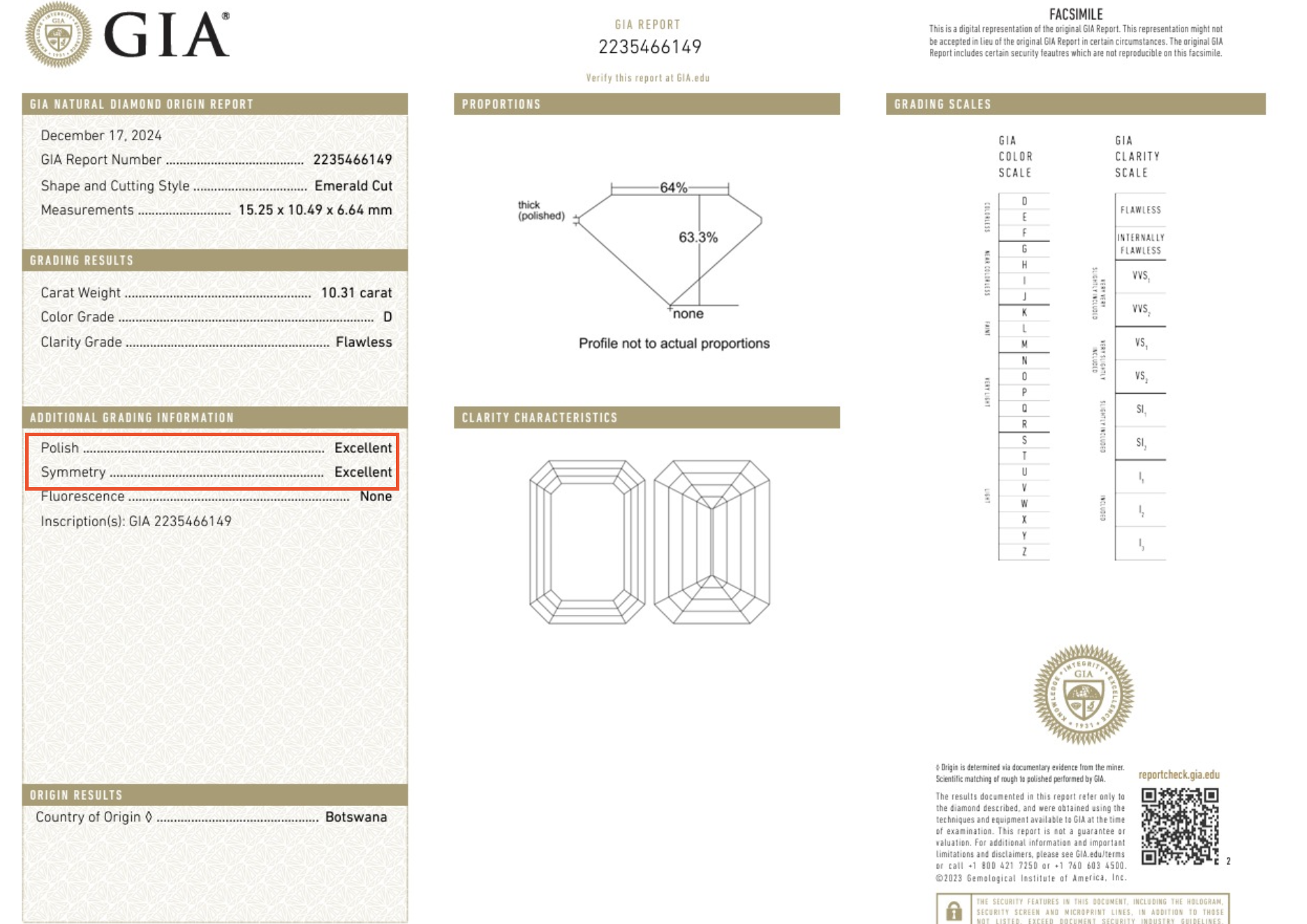
How to read a GIA report
Every GIA report follows the same layout. This is a real one, for a diamond we sold.
The grading rules
The GIA scales, grade by grade
Hover a grade, or tap it on your phone, to see what it means. Below each scale: what GIA itself says, with a link to its page.
Colour · 23 grades, D to Z
From colourless to light yellow
DEFGHIJKLMNOPQRSTUVWXYZ
ColourlessNear colourlessFaintVery lightLight
GIA grades colour face-down under controlled light, by comparing the stone with master stones of known colour. It started at D so the new scale wouldn’t be confused with the older A, B, C systems.
“Today, the D-to-Z diamond color scale as followed by the GIA laboratory is regarded globally as the universal standard for color grading.”GIA
Source: GIA, Diamond Color ↗
Clarity · 11 grades, FL to I3
From flawless to included
FLIFVVS1VVS2VS1VS2SI1SI2I1I2I3
FlawlessIFVVSVSSIIncluded
Inclusions are inside the stone, blemishes on its surface. The grade depends on their number, size, relief, nature and position, all judged at 10×.
“Most diamonds you see in jewelry stores fall between VS (very slightly included) and the SI (slightly included) on the clarity grading scale.”GIA
Source: GIA, Diamond Clarity ↗
Cut · 5 grades, round brilliants
Excellent, Very Good, Good, Fair, Poor
ExcellentVery GoodGoodFairPoor
What GIA looks at to set the cut grade:
BrightnessFireScintillationWeight ratioDurabilityPolishSymmetry
Only standard round brilliants get a cut grade: their 57 or 58 facets are standardised. Ovals, pears, emeralds and other fancy shapes get polish and symmetry only.
“A diamond’s cut refers to how it interacts with light.”GIA
Source: GIA, Diamond Cut ↗
Carat · 1 ct = 0.2 g
Weight, not size
0.25 ct0.50 ct0.99 ct1.00 ct1.50 ct2.00 ct
GIA weighs to the thousandth and reports to the hundredth. Two stones of the same weight can look different in size, depending on the cut.
“Carat measures weight, not size. A metric carat is defined as 200 milligrams.”GIA
Source: GIA, Diamond Carat Weight ↗
The story
How a jeweller who lost everything created the 4Cs
Robert M. Shipley owned several jewellery stores. Two of his best customers showed him how little he really knew about gems. Humbled, and having lost his business in a divorce, he set out to reinvent himself.
He completed a correspondence course in gemology with Britain’s National Association of Goldsmiths and came home with a mission: the American jewellery trade had no shared standards, and trust was notoriously low. Every gemologist, he believed, should have proper training and use the same criteria to buy and sell. In 1931 he founded the Gemological Institute of America.
Other labs
The other labs the trade respects
Antwerp, 1973
HRD Antwerp
The lab of the Antwerp diamond trade. Known for its cut grading, a good alternative for diamonds in Europe.
Which labs to trust →Basel, 1974
SSEF
A world leader for rubies, sapphires, emeralds and pearls.
Lucerne, 1923
Gübelin Gem Lab
The report you see on top coloured stones at auction.
FAQ
Quick answers
Is GIA the best diamond lab?
For natural diamonds, GIA is the strictest reference and the one buyers worldwide recognise. That is why GIA stones usually sell for more.
Can GIA make a mistake?
Yes. Grading is done by people, so a grade can be off, and two labs can disagree. GIA’s reputation is worth a lot, but it is never a total guarantee.
How do I check a GIA report?
Enter the 10-digit number on GIA Report Check. The weight, measurements and grades must match your paper, and the number should be inscribed on the stone.
What is the smallest diamond GIA grades?
0.15 ct for a single loose natural diamond.
Does GIA say what a diamond is worth?
No. A report grades the stone. It never states a price. For a value, ask for an appraisal.
Is it a GIA certificate or a GIA report?
A report. A lab grades the stone and describes what it sees: it doesn’t certify or guarantee anything. Many people say “certificate”, but the correct term is lab report, or grading report.
Header illustration: Ajediam collage with public-domain engravings from the Wellcome Collection. Report: a GIA report for a diamond sold by Ajediam.