Diamond Prices
Read more

Is my diamond certificate real? Check a GIA, IGI or HRD report
Check the report number in one minute, find the matching inscription on the stone, spot a fake certificate, and know what a certificate does and doesn’t guarantee.
Short answer: enter the report number on the lab’s own website. If the weight, measurements and grades match your paper, and the same number is laser-inscribed on the stone’s girdle, the certificate is genuine and belongs to that diamond.
No certificate? · Free tool · 5 minutes
6 home tests that catch most fake diamonds
Rule out glass, cubic zirconia and other common imitations in five minutes. A stone that passes isn’t proven real: only a gem lab can confirm that.
Start the 6 tests →Step 1 · The paper
Check your report number now
Pick the lab on your certificate, type the report number, and we’ll open the lab’s official check with what to compare.
GIA numbers are 10 digits, top right of the report.
Step 2 · The stone
Read the laser inscription on the stone
The report number is usually inscribed on the girdle, the thin edge of the stone. Type what you read. We’ll tell you what it means and where to check it.
Step by step
How to find it
- Clean the stoneGrease on the girdle hides the text.
- Hold it in tweezersTable down, edge facing you.
- Use a 10× loupe and a bright lightTurn slowly along the girdle. The text is about 0.1 mm high.
In a setting, the inscription can be hidden behind a prong. A jeweller with a microscope can read it.
Protection
What it protects
- Against swaps: when you collect a stone after cleaning or resizing, the number proves it’s yours.
- Against fake paperwork: a report only belongs to the stone that carries its number.
- If it’s lost or stolen: police and labs can match a recovered stone to its report.
- For lab-grown: “LG” or “Laboratory-grown” on the girdle makes the origin clear for life.
Red flags
Signs of a fake certificate
The number isn’t found
Or it’s found, but for a different weight or colour. Then the paper and the stone don’t belong together.
A lab you can’t look up
“Certificates” from the seller’s own lab, or from a name with no online database, are a sales sheet, not a grading report.
No inscription on the stone
Most GIA and HRD stones carry the number on the girdle, readable with a 10× loupe. Missing isn’t proof of fraud, but ask why.
Grades that look too kind
A D-flawless stone at a discount price is a warning. Grades from lenient labs can be 2–3 grades too high.
A photocopy or a PDF only
Ask for the original. Modern reports have security features: holograms, microprint, a QR code to the lab.
“Appraisal” sold as a certificate
An appraisal states a price, often an insurance replacement value. It doesn’t identify or grade the stone the way a lab does.
The labs
Which lab can you trust?
GIA · USA, 1931
Gemological Institute of America
Created the 4Cs and the grading system the world uses. Non-profit. The reference for natural diamonds above one carat.
GIA Report Check →Other labs
Grades vary by lab
Labs differ in how strictly they grade colour and clarity. For a natural diamond, GIA is the strictest reference, so compare stones graded by the same lab.
Check any report →HRD · Antwerp, 1973
HRD Antwerp
The lab of the Antwerp diamond trade, ISO 17025 accredited. Strong in Europe and Asia.
HRD Report Check →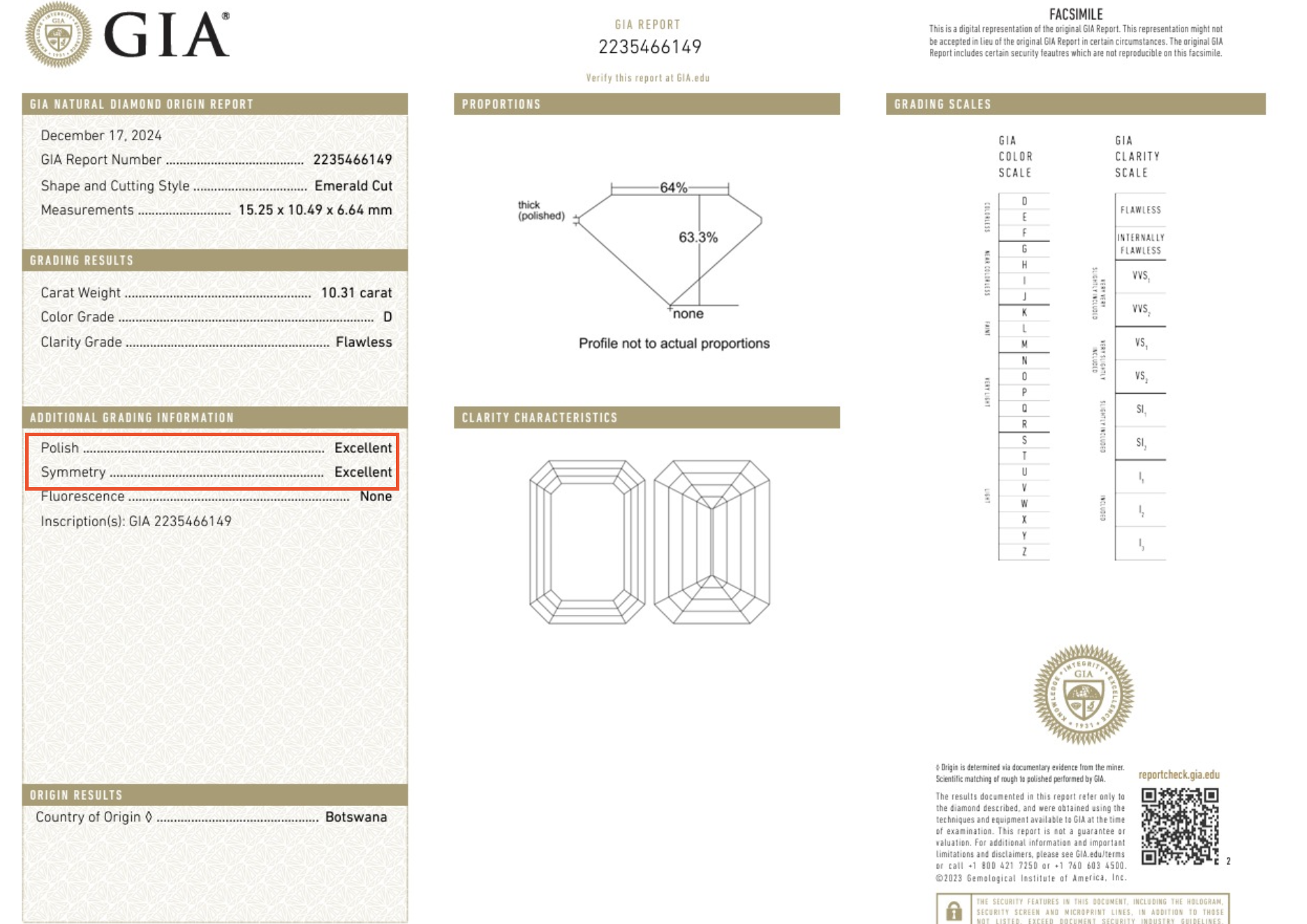
Example
What a real report looks like
A GIA report for a 10-carat emerald cut we sold. Every grade on it can be checked online, and the number is inscribed on the stone.
At Ajediam, our diamonds come with a GIA or HRD report, inscribed with its number. We show it to you under the loupe before you buy.
Step 3 · The seller
What a certificate doesn’t guarantee: 6 things to ask before you pay
A report grades the stone. It doesn’t promise returns, a warranty or a buyback. Tick what your seller offers. Missing items show what to ask for.
Origin
Conflict-free: the Kimberley Process
Since 2003, rough diamonds cross borders only in sealed parcels with a Kimberley Process certificate, so they can’t fund wars. The trade then passes the promise on through the World Diamond Council’s System of Warranties: every invoice states the diamonds are conflict-free.
The KP certificate travels with rough, not with your polished stone. Your proof is the warranty statement on the invoice. kimberleyprocess.com · WDC System of Warranties
Ajediam
Our guarantees
Buyback at market value
We buy back the diamonds we sell at their market resale value.
How buyback works →FAQ
Quick answers
Is a diamond without a certificate fake?
No. Many older and smaller diamonds were never graded. You can have one graded today.
Which diamond certificate is the best?
GIA. It is the report the trade and buyers worldwide use as the reference, and the strictest on colour and clarity. HRD Antwerp is a good alternative in Europe.
Can a certificate be swapped to another stone?
That’s the classic swap. The laser inscription and the exact weight and measurements tie the report to one stone.
What is a “certificate of authenticity”?
Usually a lab grading report. If the seller wrote it, it’s not independent.
Does a laser inscription damage the diamond?
No. It’s a few microns deep on the girdle and doesn’t change the grade or the value.
Can an inscription be removed?
It can be polished off, which loses a little weight. A missing inscription on a stone sold with a report is a reason to ask questions.
Header illustration: Ajediam collage with public-domain engravings from the Wellcome Collection.